How to choose a surf camera housing, plus 10 options for 2026
A water housing decides whether you can shoot surf from the water at all. It must fit your exact camera and lens, survive lips and whitewater, and let you fire the shutter with one hand while you kick with fins. This guide covers the choices that matter in the line-up, how to keep a housing dry, and ten options on sale in 2026.
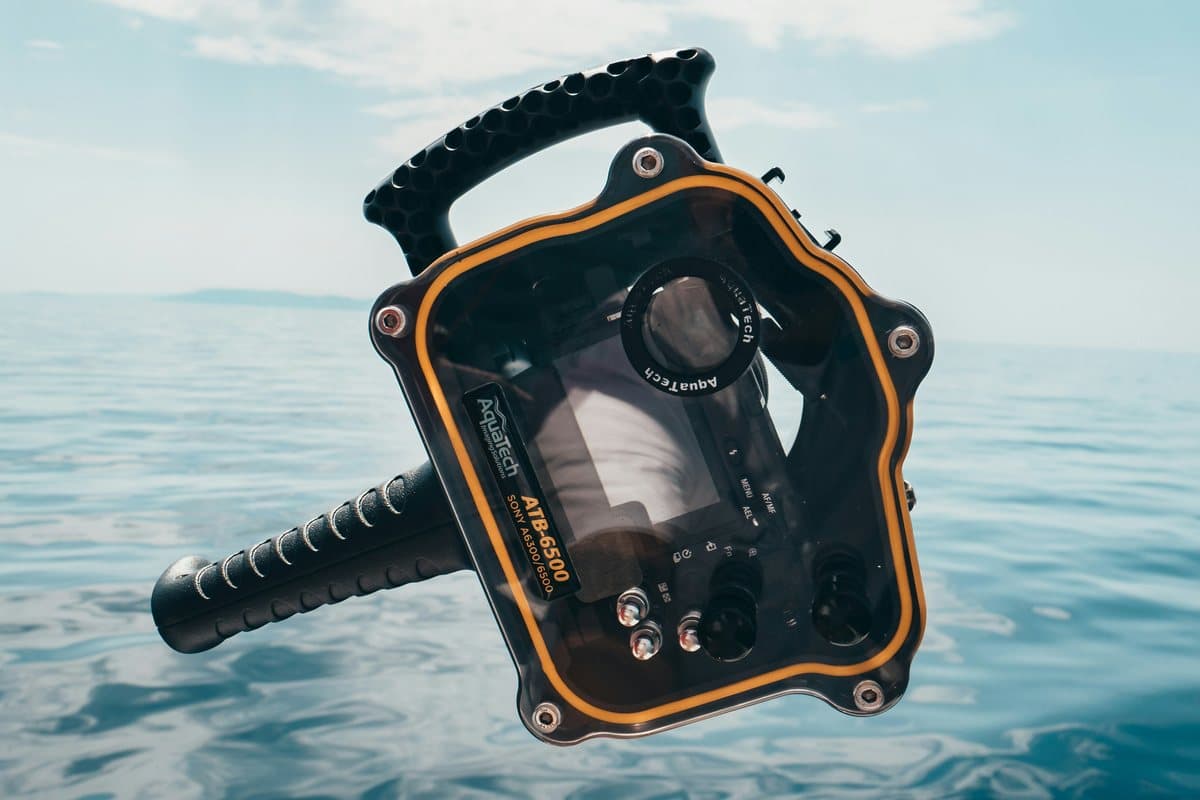
Surf housing or dive housing?
Surf housings are built for the surface: compact, light, shaped around a pistol grip and rated for shallow water (AquaTech's EDGE housings to 10 m). Many reach only the controls you need mid-session, so you set the camera up on the beach.
Dive housings from brands such as Nauticam or Ikelite are rated to 60 m or more and reach almost every button, but they weigh more. Liquid Eye blurs the line, rating its C2090 to 30 m. Only shooting surf? Prioritise grip, weight and ports.
Flat port or dome port: match it to the lens
The port is the window in front of the lens, and it must match that lens. Flat ports suit standard and telephoto lenses, such as a 50 mm or 70-200 mm, shot from the surface in the channel. Underwater they magnify by about 25 percent and soften wide-angle edges, which doesn't matter above the waterline.
Dome ports suit wide-angle and fisheye lenses: they restore the field of view underwater for close barrel shots and over-unders. Check the maker's port chart for the port, extension ring and zoom gear each lens needs. Many photographers wipe a film of saliva or an anti-droplet treatment on the dome so water sheets off.
Pistol grip and trigger
Most surf photographers shoot one-handed from a pistol grip and swim with the other hand. The best triggers are electronic and two-stage: half-press to focus, full press to fire. AquaTech's M3 grip and most surf-specific triggers work this way.
Check how the trigger connects: GDome, for example, needs a TRS wired remote socket on the camera. If you use back-button focus, make sure AF-ON falls under your thumb, and set shutter speed, AF area and custom buttons before you close the housing.
Weight, buoyancy and safety
An AquaTech EDGE Pro weighs about 1.4 kg and a Liquid Eye C2090 for the Canon R5 Mark II about 1.5 kg, before camera, lens and port. Big domes and small cameras make a housing float nose-up, and a housing close to neutral is easier to hold steady; AquaTech sells a weight bracket to trim it.
Use a wrist leash every time. Stay in or near the channel, wear fins, never swim over shallow reef on big days and keep out of a crowded take-off zone: surfers have right of way.
Leak detection and vacuum systems
A moisture alarm warns you once water is already inside. A vacuum system warns you before you get wet: you pump air out of the sealed housing and a sensor watches the pressure. If it drops, something is leaking. Nauticam's LED turns steady green at the target vacuum, and Nauticam recommends waiting at least 20 minutes to confirm the seal. If it warns, open the housing on the beach, never in the surf.
O-ring care
Most floods start at the main o-ring: a hair, sand, a nick or a twisted seal. Wipe the o-ring and its groove and check them in good light before closing. Use only the maker's lubricant, as a light sheen; excess grease collects sand, and some seals are designed to run dry. Ikelite suggests replacing the main o-ring once a year or when damaged. After each session, soak the housing in fresh water, work every button and dry it in the shade.
Compatibility with your exact camera
Hard housings are made for one body, sometimes two or three related ones, and buttons move between generations. Check that the maker lists your exact camera and check the port chart for every lens. Universal and soft housings fit many cameras but reach fewer controls. Buying second-hand? Confirm the model, inspect the port and replace the o-rings.
10 surf housings and options for 2026
All were on sale from the maker in September 2026, running from professional surf housings to universal, action-camera and phone options.
- AquaTech EDGE Pro and EDGE MAX Camera-specific polycarbonate surf housings with metal controls, rated to 10 m. EDGE Pro fits bodies such as the Canon R5 Mark II and Sony a7R V; EDGE MAX fits large bodies like the Nikon Z8. For working professionals.
- AquaTech EDGE Base A plain back plate with no controls: you set the camera before closing it and shoot with the shutter release. It uses the same port system, so it is a professional build for a tighter budget.
- Liquid Eye C2090 Polyurethane surf housing with a single-latch closure and a two-stage electronic front shutter, rated to 30 m with small domes or low-profile flat ports. Made for Canon, Sony, Nikon and Panasonic, with an optional vacuum system. Suits photographers who also dive.
- SeaFrogs Salted Line A common entry-level to mid-range choice, mainly for Sony, with Canon and Fujifilm models too. Rated to 40-60 m, with a vacuum port, leak sensor and optional two-stage grip.
- Ikelite 200DL A 60 m dive housing in light ABS-polycarbonate with a clear back to check the o-ring; Deluxe versions include a vacuum pump. Bulkier than a surf housing, but it already covers new bodies such as the Canon R6 III and Sony a7 V. For divers who also shoot surf.
- Nauticam Aluminium dive housings with an electronic vacuum check, moisture alarm and access to nearly every control, including recent models for the Sony a7 V and Nikon ZR. For photographers who shoot underwater as much as surf.
- GDome XL 4 A universal semi-rigid housing for thousands of camera and lens combinations, rated to 18 m with the solid back door, with dome or flat ports and a two-stage surf trigger. Your camera needs a TRS wired remote socket. For photographers who switch bodies often.
- Outex A soft silicone cover with optical glass ports, waterproof to 10 m and adaptable to almost any camera. Light for travel and a budget starting point, with less impact protection than a hard housing.
- GoPro Protective Housing GoPros are waterproof on their own; the matching housing adds depth and impact protection, rated to 60 m for the MISSION 1 series. The simplest way to start shooting from the water.
- JOBY SeaPal A phone housing developed with AquaTech, rated to 10 m, with touchscreen access and an optional Bluetooth grip. It fits iPhone 12 to 16 and Galaxy S22 to S24, but not the iPhone 17 Pro or Pro Max. For phone shooters trying the water.
Frequently asked questions
Can I use a dive housing for surf photography?
Yes. Dive housings from Nauticam, Ikelite or SeaFrogs are regularly used in surf and give access to more controls. The downsides are weight, bulk and, on some models, no pistol-grip trigger.
Which lens and port should I start with in the water?
Many water photographers start with a wide-angle or fisheye lens behind a dome, shooting close to the wave, because it forgives framing errors and allows over-unders. A 50 mm or longer lens behind a flat port works from the channel but demands good wave reading.
Do I need a vacuum leak detector on a surf housing?
It isn't mandatory, but it's the only way to confirm the seals are closed before you swim out. A moisture alarm only warns once water is inside. If your housing supports one, use it every session, especially after changing a lens or port.
How often should a surf housing be serviced?
Inspect the main o-ring every time you open the housing and replace it about once a year. Backscatter suggests a full service roughly every two years, sooner if buttons start to stick.